TRT Symptom Tracker: Log Symptoms, Injections, Labs
How to keep a TRT symptom log: energy, mood, sleep, side effects, injections and labs on one timeline, with a sample 12-week log for your clinician.

By Dosi Team · Updated 2026-11-18 · Educational information only, not medical advice.
A TRT (testosterone replacement therapy) symptom tracker lets you record how you feel (energy, mood, sleep, side effects) on the same timeline as your injection dates and lab results, so patterns are visible instead of remembered. This guide shows what to log, how often, a sample 12-week timeline, and how to bring the record to an appointment. It is written by the Dosi Team, who make a tracking app, and is not medical advice.
Key takeaways
- Symptoms are only useful when you can see them next to injection timing and labs.
- Log consistently on a schedule you can keep, even if it is a few lines.
- Log symptoms, but for anything urgent, get help first and log it afterwards.
- A tracker is a record to discuss with your clinician. It does not interpret results or adjust anything.
Why track symptoms, not just injections
Injection dates answer "what did I do." Symptoms answer "how did that week feel." Clinical guidelines treat symptom and adherence monitoring as part of care. Two 2018 guidelines point the same way:
- The Endocrine Society's guideline on testosterone therapy in men with hypogonadism says a diagnosis needs symptoms and signs of low testosterone.
- It also needs clearly low testosterone on repeated fasting morning blood tests.
- Men on therapy should be monitored to a set plan. In the first year, that means checking symptoms, side effects and whether the treatment is taken as planned. It also means blood tests for testosterone and hematocrit, and a check of prostate cancer risk.
- The American Urological Association's guideline on testosterone deficiency agrees. Care should focus on total testosterone, symptoms and signs, and monitoring during treatment.
A symptom and injection log is your half of that plan. It is easy to forget details between visits, and visits are short. A written record lets you say "my energy notes dipped late in the cycle for the last three weeks" instead of "I think I felt tired sometimes."
What to log
- Injections: date, time, compound or ester as prescribed, amount, route and site.
- Symptoms and side effects: what you noticed and when. Useful prompts: swelling, sleep, mood, libido, acne, and blood pressure readings if you take them.
- Daily notes: energy, mood, sleep, training, in whatever words you use.
- Weight: entered manually or synced from Apple Health or Health Connect.
- Labs: the marker, value, units, reference range and the date and time of the draw. Any marker can be entered, so a custom panel is fine.
Why record the draw time: the Endocrine Society guideline abstract recommends fasting morning total testosterone as the initial diagnostic test and monitoring hematocrit during therapy. Noting where in your injection cycle a draw fell gives your clinician the same context.
On the label side, the testosterone cypionate prescribing information says hemoglobin and hematocrit should be checked periodically in patients on long-term androgen therapy.
Recording the draw date next to your injection dates lets your clinician see where in the cycle each draw fell. An invented lab entry looks like this: Hematocrit, 46%, reference range as printed on the report, drawn Tue 8:10 AM fasting, day 1 after injection. The log records it. It does not say whether the value is good or bad.
Worked example: a 12-week timeline
This is invented, to show the shape of a useful record. Amounts and schedule are omitted on purpose: they come from your prescription. Symptom scores use a personal 1 to 5 scale that you define once and keep consistent, and each is a weekly summary of your daily notes. They are not a validated instrument.
| Week | Injection day | Energy (1-5) | Mood (1-5) | Sleep (1-5) | Notes and labs |
|---|---|---|---|---|---|
| 1 | Mon | 3 | 3 | 3 | Baseline week, no changes; Labs: Draw Tue AM, fasting; recorded as printed on the report |
| 2 | Mon | 3 | 3 | 3 | none |
| 3 | Mon | 4 | 3 | 3 | Training felt easier |
| 4 | Mon | 4 | 4 | 4 | none |
| 5 | Mon | 3 | 3 | 3 | Travel week, poor sleep |
| 6 | Mon | 4 | 3 | 4 | Mild acne on shoulders |
| 7 | Mon | 4 | 4 | 4 | none |
| 8 | Mon | 3 | 3 | 4 | Low energy Sat and Sun (day 5-6 after injection) |
| 9 | Mon | 3 | 2 | 4 | Low energy Sat and Sun again |
| 10 | Mon | 4 | 4 | 4 | none |
| 11 | Mon | 3 | 3 | 3 | Low energy Sat and Sun, third time in four weeks |
| 12 | Mon | 4 | 4 | 4 | Wrote up questions for the visit; Labs: Draw Tue AM, fasting; recorded as printed; appointment Thu |
How to read it. Scores will vary, and a single low day proves little. What stands out is the repeated weekend dip in weeks 8, 9 and 11, anchored to the day count since the injection. A specific pattern like that is worth raising with a clinician, who decides whether it matters and whether anything should change. The two lab rows sit 11 weeks apart, each tied to a draw time. The log supplies context for the clinician.
When to call your doctor
A tracker is not a safety system. It cannot tell you that something is wrong, and it will not alert anyone for you. Use this list as a reminder to act on symptoms, not just record them. It is general guidance, not a complete list. The prolonged erection, blood clot, blood pressure and swelling items come from the warnings in the testosterone cypionate prescribing information. The stroke, chest pain and leg clot signs are widely recognised emergency warning signs rather than items from that label. This label covers testosterone cypionate only. Your own product's label and your clinician have the full list.
Get emergency help right away (911 in the US, or your local emergency number) for:
- Chest pain or pressure, or trouble breathing.
- Sudden weakness or numbness on one side of the body, trouble speaking, or a sudden severe headache.
- Pain, swelling or redness in one leg, especially with shortness of breath.
- A painful or prolonged erection.
- Thoughts of harming yourself. In the US you can call or text 988.
Contact your clinician promptly (the same day if you can) for:
- Swelling in your ankles or feet, or blood pressure readings that jump.
- Fever, spreading redness, warmth or pus at an injection site.
- Large or sudden changes in mood, sleep or behavior.
- Any symptom that worries you, or that is new since you started.
Write these in your log too, with the date, so the record is complete. But do not wait for the next appointment to report them.
Bringing the record to an appointment
- Pick the window to show, for example the last 12 weeks.
- Mark your injection days and the dates of any lab draws.
- Write down the two or three patterns you want to ask about, such as the weekend dips in the example above.
- Add your questions, and any side effects with their dates.
- Bring it on your phone or as a printout, and let your clinician decide what it means.
A simple routine that is easy to keep
- Log each injection right after it, including the site. The injection site map shows how a rotation record looks.
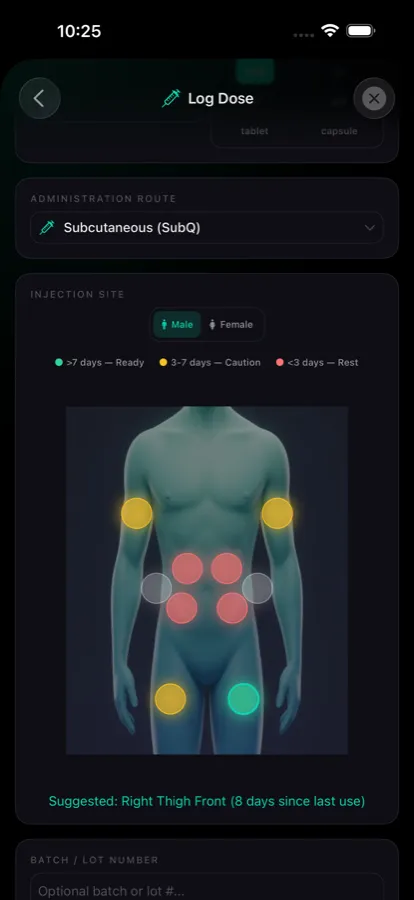
Logging an injection with its site in the Dosi iPhone app. The route shown is subcutaneous; the app also supports intramuscular entries.
- Add a short note on the same days each week, so gaps do not hide patterns.
- Enter lab results when you get them, with the draw date.
- Before an appointment, review the timeline and write down your questions.
Half-life curves: what they show and what they do not
Dosi can draw half-life curves from published data for the compounds you log. They give a picture of timing between injections. They are a general illustration, not a measurement of your own levels, and they do not replace lab work. The half-life calculator lets you explore the idea without an account.
Spreadsheet, notes app or tracker?
A notes app is quick but hard to chart or filter over months. A spreadsheet can hold structure, but charts, site history and reminders take work. A tracker does that formatting for you. Dosi also covers peptides and GLP-1s, in case your routine includes more than one therapy. Read how we write these guides in our medical disclaimer. See the TRT tracker for the full feature list, or start the 14-day trial (payment method required to start).
Frequently asked questions
What should a TRT symptom tracker include?
Injection dates and sites, symptoms and side effects, weight, and lab results, all on one timeline with reminders.
How often should I log symptoms?
Whatever you can keep up. A fixed day each week, plus anything unusual, is easy to keep. Your clinician may suggest a schedule.
Can Dosi interpret my lab results?
No. Dosi stores your results so you can review them over time. Interpretation belongs to you and your clinician.
Is Dosi free?
There is a 14-day free trial. A payment method is required to start the trial.
Is the data on the half-life curve my actual hormone level?
No. It is an illustration drawn from published half-life data. Only lab tests measure your levels.
Sources
- Bhasin S et al. Testosterone Therapy in Men With Hypogonadism: An Endocrine Society Clinical Practice Guideline. J Clin Endocrinol Metab 2018;103(5):1715-1744: diagnosis needs symptoms plus consistently low morning testosterone; monitoring includes symptoms, adverse effects, compliance, testosterone, hematocrit and prostate cancer risk in the first year.
- Mulhall JP et al. Evaluation and Management of Testosterone Deficiency: AUA Guideline. J Urol 2018;200(2):423-432: care should focus on total testosterone, symptoms and signs, and on-treatment monitoring.
- Testosterone cypionate injection, prescribing information on DailyMed: hemoglobin and hematocrit should be checked periodically during long-term androgen administration.
About the Dosi Team
The Dosi Team makes Dosi, a tracking app. We are not clinicians, and this post has not been reviewed by one. It is educational and describes how to keep a record, not what to take. Questions or corrections: contact Dosi support. Read the full medical disclaimer. Sources are listed above.
Educational information only. Dosi is a tracking tool, not medical advice. It does not recommend doses or treatments. Talk to your clinician about your own routine.
Keep symptoms, injections and labs on one timeline
Dosi records injections, symptoms and lab results together so you can review the pattern and bring questions to your clinician. Tracking only. Not medical advice.
Start 14-Day Trial →