A clear separation between online claims, limited human data, and regulatory findings
A short synthetic peptide with a large marketing footprint and a very small human evidence base
BPC-157 is an unapproved synthetic peptide promoted online for injury recovery and other uses. FDA's 2026 review identified five very small human studies or abstracts, but their size, design, monitoring, and reporting do not establish effectiveness or characterize uncommon harms. A registered randomized hamstring-strain trial has not yet posted results, and FDA has identified unresolved immunogenicity, impurity, and characterization concerns.
Evidence audited · Sources and limitations shown beside each claim
Molecular identity
What the molecule actually is
Classification
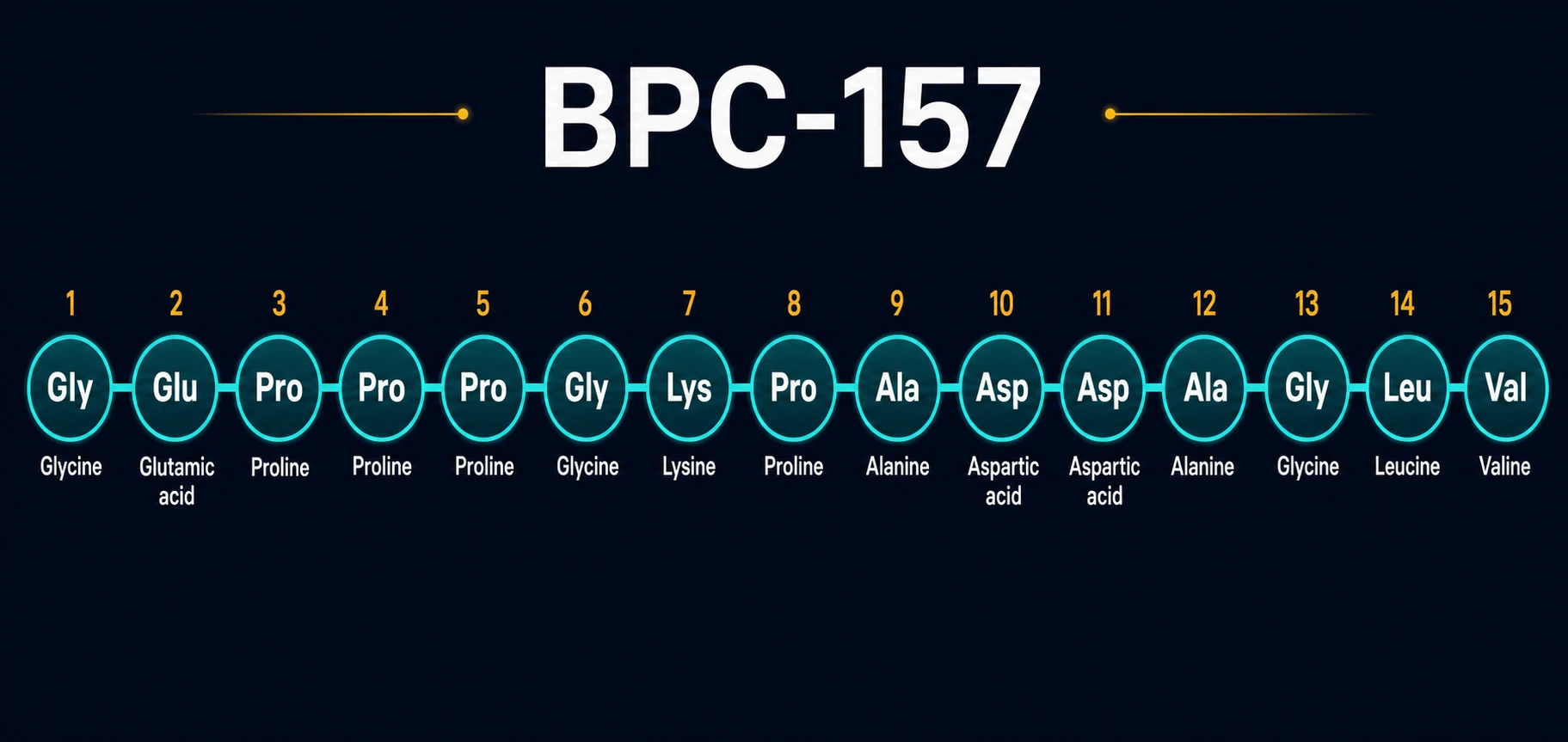
Synthetic 15-residue peptide; free-base and acetate forms are distinct substance records
BPC-157 has no approved U.S. drug, prescription denominator, or reliable surveillance dataset. Seller volume, search interest, social posts, adverse-event reports, and Dosi tracking activity cannot be converted into a patient count.
Scale of the human record reviewed by FDASelected reported exposures across five small studies or abstracts; this is an evidence-size map, not an efficacy comparison.
Rectal-enema study24
Ulcerative-colitis reportabout 26
Knee-pain report17
Interstitial-cystitis report12
IV pilot2
Short, small, incompletely monitored studies cannot establish general safety or effectiveness; categories may not be pooled as one controlled trial.
No validated human molecular target has been identified. Angiogenesis, growth-factor, inflammatory, and nitric-oxide explanations come from nonclinical work and should be treated as hypotheses.
01
Nonclinical signals
Cell and animal studies generate hypotheses involving tissue response and signaling pathways.
Evidence boundary: A plausible pathway in a laboratory model is not proof that an administered product repairs a tendon, muscle, gastrointestinal injury, or other condition in people.
Product and regulatory distinctions
A compound name is not one interchangeable set of instructions. Product, formulation, indication, labeling, and jurisdiction matter.
BPC-157 drug products
No FDA-approved BPC-157 drug product is identified in FDA's current compounding assessment; compounded products do not undergo FDA premarket review for safety, effectiveness, or quality.
Ahead of the July 23, 2026 advisory-committee meeting, FDA proposes that BPC-157 free base and acetate not be added to the 503A Bulks List. This is a proposal, not a final determination.
Each finding is tied to the population and product actually studied. Trial results are not personal predictions.
Observational human evidence
Published human safety evidence for intravenous BPC-157 is limited to a very small pilot.
Population
Two healthy adults who had both previously received intravenous BPC-157.
Finding
The investigators reported no side effects or measured changes in the selected laboratory markers during the short observation period.
Limits
Two previously exposed participants, no control group, short follow-up, and a private-clinic setting cannot establish general safety, detect uncommon harms, or support any effectiveness claim.
A randomized trial is studying BPC-157 for acute grade II hamstring strain.
Population
Planned enrollment of 120 adults with MRI-confirmed acute grade II hamstring strain.
Finding
ClinicalTrials.gov lists the phase 2 study as recruiting, with no results posted; registration is evidence that research is underway, not evidence of benefit.
Limits
The estimated primary completion is in 2027. No efficacy or safety conclusion can be drawn before results are completed, reported, and critically reviewed.
An older registered oral phase 1 BPC-157 study does not provide public results.
Population
The registry described healthy volunteers aged 18 to 35.
Finding
ClinicalTrials.gov records a planned safety and pharmacokinetics study, but the record has no posted study results.
Limits
A registration without results cannot establish safety, pharmacokinetics, or effectiveness, and oral findings would not automatically transfer to injected products.
●No completed, adequately powered randomized human trial establishes that BPC-157 improves tendon, ligament, muscle, gastrointestinal, or postoperative recovery.
●Long-term human safety, reproductive effects, immunogenicity, interactions, and effects in people with major health conditions are not established.
●The identity, concentration, sterility, storage history, and impurity profile of a product sold online cannot be inferred from its label.
●Evidence from cells or animals does not establish a human clinical benefit, dose, or safety profile.
Useful information to organize between visits
✓Exact product name, seller or dispensing pharmacy, lot number, formulation, and labeled ingredients
✓Route and date of any exposure, recorded without using this page to choose a dose
✓Reason for use and any concurrent rehabilitation or treatment, so changes are not attributed to the peptide automatically
✓Symptoms with onset, severity, duration, and any urgent evaluation
✓Photographs of packaging and any certificate supplied, while recognizing that a certificate does not independently prove vial contents
Questions to bring to a clinician or pharmacist
1.What established diagnostic and treatment options address the injury or symptom I am trying to manage?
2.Could this product interact with my conditions, medicines, planned procedure, or anti-doping obligations?
3.What symptoms after exposure require urgent evaluation or an adverse-event report?
4.How can the product identity, sterility, and source be assessed, and what cannot be verified from the label?
How to use this research profile
This page aggregates regulatory documents and published human research. Its claims, citations, populations, and limitations received an independent editorial evidence check. Last editorial audit: . It has not been medically reviewed by a clinician. It provides general education, not diagnosis, treatment, dosing instructions, or advice for an individual. Use the product-specific official information and consult a qualified clinician or pharmacist for personal decisions.